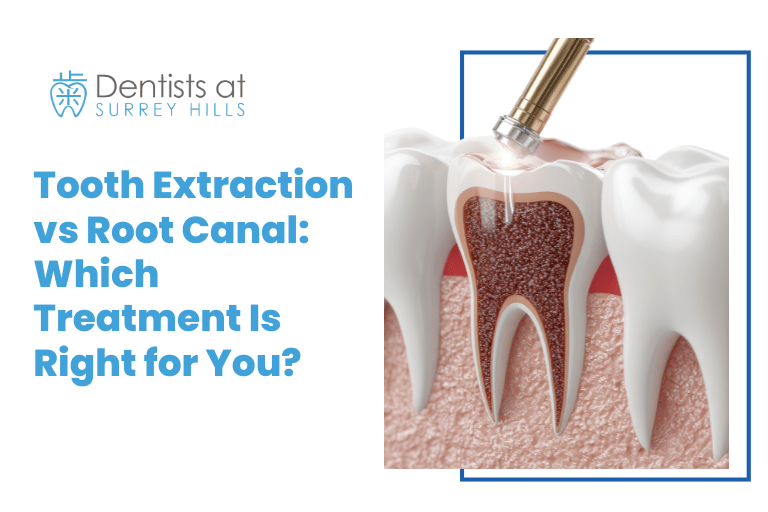
If a tooth is badly damaged or infected, you may be told that you need either a root canal or a tooth extraction. The main difference is simple: root canal treatment aims to save the natural tooth, while an extraction removes it.
Which treatment is right for you depends on how much healthy tooth remains, the condition of the roots and surrounding bone, the extent of the infection, and whether the tooth can be restored successfully.
If the tooth can be saved and is likely to remain functional, root canal treatment may be an option. If the damage is too severe for the tooth to be repaired, extraction may be necessary.
Root Canal vs Tooth Extraction at a Glance
| Root Canal Treatment | Tooth Extraction | |
| Main purpose | Save an infected or damaged tooth | Remove a tooth that cannot or should not be retained |
| What happens | Infected or damaged pulp is removed and the inside of the tooth is cleaned and sealed | The entire tooth is removed from its socket |
| Natural tooth remains? | Yes | No |
| Restoration | A filling or crown may be needed afterwards | The gap may need to be replaced |
| Recovery | Some temporary tenderness may occur | The extraction site needs time to heal |
| Best suited to | Teeth that can still be successfully restored | Teeth that are too damaged or unsuitable to save |
The choice cannot be made from symptoms alone. A dentist usually needs to examine the tooth and may take an X-ray before recommending treatment.
When Is Root Canal Treatment a Better Option?
Root canal treatment may be recommended when the pulp inside a tooth has become badly inflamed, damaged or infected but the tooth itself can still be restored.
This can happen because of:
- deep tooth decay
- a crack or injury
- infection inside the tooth
- repeated dental work on the same tooth
- damage to the pulp
During root canal treatment, the damaged or infected pulp is removed from inside the tooth. The root canals are then cleaned, shaped and sealed to prevent bacteria from re-entering.
The aim is to treat the problem inside the tooth without removing the tooth itself.
Internal damage or infection can sometimes also cause a tooth to turn dark or black, although tooth discolouration can have several different causes.
After root canal treatment, the tooth needs to be properly restored. Depending on how much tooth structure remains, this may involve a filling or a crown to protect the tooth and allow it to function normally.
When Might a Tooth Need to Be Extracted?
Saving a natural tooth is not always possible.
An extraction may be recommended when a tooth is so badly damaged that there is not enough healthy structure left to restore it successfully.
This may happen with:
- severe decay that has destroyed much of the tooth
- a major crack or fracture
- infection that cannot be successfully treated
- serious damage to the supporting structures around the tooth
- a tooth with a poor long-term outlook even after treatment
The decision is not simply based on whether a tooth is infected. An infected tooth may still be treatable with a root canal. Extraction becomes more likely when the tooth itself cannot be predictably restored or maintained.
The decision is not simply based on whether a tooth is infected. An infected tooth may still be treatable, and root canal treatment can help save a damaged or infected tooth. Extraction becomes more likely when the tooth is too badly damaged to be successfully restored.
Is a Root Canal Better Than an Extraction?
Not automatically.
If a damaged tooth can be treated successfully, keeping your natural tooth means it can continue to help you bite and chew.
But this does not mean every tooth should be saved at any cost.
A root canal is only useful if the remaining tooth is strong enough to be restored and has a reasonable long-term outlook. If a tooth is severely fractured, extensively decayed or otherwise unlikely to remain functional, extraction may be the more appropriate treatment.
The better option is the one that gives you a healthy and functional result over the longer term.
What Happens After a Root Canal?
Root canal treatment removes the damaged or infected tissue from inside the tooth, but the tooth still needs to be protected afterwards.
Once the canals have been cleaned and sealed, the tooth is restored with a filling or, in many cases, a dental crown. Teeth requiring root canal treatment may already have lost a significant amount of structure because of decay, cracks or previous dental work.
The restoration helps protect the remaining tooth and allows it to function again.
Root canal treatment may also take more than one appointment, depending on the tooth and the complexity of the infection.
What Happens After a Tooth Extraction?
After an extraction, the socket where the tooth was removed needs time to heal.
You may experience some pain, swelling or minor bleeding afterwards. Your dentist will give you instructions about looking after the area while it heals.
It is important to protect the blood clot that forms in the socket, as disturbing it can interfere with normal healing.
Once the area has healed, another question may need to be considered: does the missing tooth need to be replaced?
Will You Need to Replace an Extracted Tooth?
Not every extracted tooth needs to be replaced, but leaving a gap can sometimes affect your bite, chewing or the position of nearby teeth.
Depending on which tooth was removed and your individual situation, replacement options may include:
- a dental implant
- a dental bridge
- a partial denture
Extraction may initially seem like the simpler option because the problem tooth is removed. However, if that tooth then needs to be replaced, the complete treatment may involve additional appointments, procedures and costs.
For this reason, it makes more sense to compare the whole treatment plan, not just the root canal procedure with the extraction itself.
Which Treatment Costs More?
The answer depends on what treatment is needed after the initial procedure.
A tooth extraction may cost less than root canal treatment on its own. However, if the missing tooth later needs to be replaced with an implant, bridge or denture, there will be additional treatment and costs.
Root canal treatment may also involve several stages, and a crown may be recommended afterwards.
Rather than choosing between the two based only on the first procedure’s price, consider what will be required to leave you with a comfortable and functional tooth — or a suitable replacement for it.
Is Recovery Different?
Yes.
After a root canal, the treated tooth and surrounding area may feel tender for a short period, but the tooth remains in place.
After an extraction, your body needs to heal the socket left by the removed tooth. You may need to be more careful about eating, cleaning the area and disturbing the blood clot during the early stages of healing.
The exact recovery experience varies depending on the tooth, the complexity of the treatment and your individual health.
How Does a Dentist Decide Between a Root Canal and Extraction?
Your dentist will look at more than how painful the tooth feels.
The assessment may include:
- how much healthy tooth structure remains
- whether the tooth is cracked or fractured
- the condition of the tooth root
- the extent of decay or infection
- the health of the bone and gums supporting the tooth
- whether the tooth can be restored after treatment
- the likely long-term outlook for the tooth
Dental X-rays may also be used to examine the roots and surrounding bone, look for infection and understand how far the problem has progressed.
Two teeth causing similar pain can therefore require very different treatments.
Can You Choose to Have the Tooth Removed Instead?
In some situations, both root canal treatment and extraction may be possible options.
However, removing a tooth is permanent. Once the tooth has been extracted, it cannot later be restored with a root canal.
Before making that decision, it is worth understanding whether the tooth can realistically be saved, what treatment would be needed afterwards and whether an extracted tooth would need to be replaced.
An experienced dental professional can examine the tooth and explain the likely outcome of each option before you decide how to proceed.
The Bottom Line
The main difference between a root canal and tooth extraction is that a root canal tries to save the natural tooth, while an extraction removes it.
If the tooth is still strong enough to be restored, root canal treatment may allow you to keep it. If the damage is too extensive or the tooth has a poor long-term outlook, extraction may be the more appropriate choice.
The decision should be based on the condition of the whole tooth and what will provide a healthy, functional result over the longer term.