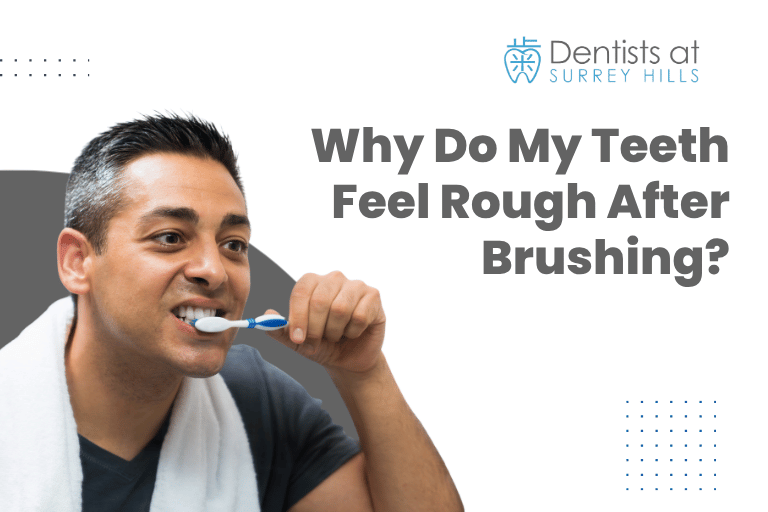
If your teeth still feel rough after brushing, the most common reasons are plaque or tartar on the tooth surface, particularly around the gumline or in areas that are difficult to clean.
Sometimes the roughness is only temporary and improves with more thorough brushing and cleaning between the teeth. But if the same area stays rough no matter how well you brush, it may be something that a toothbrush cannot remove.
The location of the roughness can also provide a clue to what is causing it.
Why Don’t My Teeth Feel Smooth After Brushing?
Clean tooth enamel generally feels fairly smooth when you run your tongue over it. If part of a tooth feels fuzzy, gritty or noticeably rough after brushing, something may still be covering the surface or the surface itself may be uneven.
Common reasons include:
- plaque that has not been completely removed
- hardened tartar
- food trapped around or between the teeth
- a rough filling, crown or other dental restoration
- a chipped or damaged tooth
- changes to the tooth surface
The feeling alone cannot tell you exactly what is causing it, but whether the roughness disappears after cleaning is a useful place to start.
Could It Just Be Plaque?
Yes. Plaque is a soft, sticky layer that continually forms on your teeth.
Your toothbrush removes plaque from the surfaces it reaches, but some areas are easier to miss. Plaque commonly remains around the gumline, between teeth and in crowded or difficult-to-reach areas.
This can leave your teeth feeling less smooth even though you have just brushed them.
If you regularly notice roughness in the same place, pay attention to whether your toothbrush is actually reaching that area. Cleaning between the teeth with floss or an interdental brush may also be needed because a toothbrush cannot thoroughly clean every surface between neighbouring teeth.
What If the Roughness Does Not Brush Away?
If an area feels hard and rough and stays that way after thorough brushing, tartar is one possibility.
Tartar, also called calculus, forms when plaque hardens on the teeth. Unlike soft plaque, calculus cannot be removed by brushing at home.
You may notice it most easily behind the lower front teeth or around the gumline, although it can develop elsewhere.
If you want to understand the difference between soft plaque and hardened build-up, our guide to tartar on teeth explains how tartar forms and how it is removed.
Can You Brush Tartar Off Your Teeth?
No. Once plaque has hardened into tartar, brushing harder will not remove it.
In fact, aggressive brushing is not the answer. Scrubbing your teeth with excessive pressure can irritate your gums and contribute to wear over time.
Tartar needs to be removed with professional cleaning equipment. Once the build-up has been removed and the teeth polished, the surfaces will often feel noticeably smoother.
Could a Filling or Crown Feel Rough?
Yes. If the roughness seems to be limited to one particular tooth, especially a tooth that has previously been treated, the surface of a filling, crown or other restoration may be responsible.
For example, you may notice:
- a rough edge
- a small chip
- a filling that no longer feels as smooth as it once did
- an area where food repeatedly catches
- a change in the way the tooth feels when you run your tongue over it
Your tongue is very sensitive to small changes, so even a minor irregularity can feel surprisingly noticeable.
Do not try to smooth a filling or tooth yourself. A dentist can check whether the surface simply needs polishing or whether the restoration or tooth has been damaged.
What If the Tooth Itself Feels Rough?
Not every rough surface is plaque or tartar.
A tooth can feel uneven if part of the enamel has been chipped, worn or damaged. Changes to the tooth surface can occur for several reasons, including acid erosion, grinding or physical wear.
If one tooth suddenly feels different, particularly if you can see a chip or notice sensitivity or pain as well, it is worth having the tooth examined.
Why Do My Teeth Feel Rough Near the Gumline?
Roughness close to the gums is often associated with plaque or tartar build-up because the gumline can be easy to miss during brushing.
If the gums around the area are also red, swollen or bleeding, that deserves attention too. Plaque and tartar around the gumline can irritate the gums and contribute to gum disease.
Brushing harder is not usually the solution. Gentle, thorough cleaning is more important than pressure.
Why Do My Teeth Feel Rough Again Soon After a Dental Clean?
Teeth usually feel very smooth immediately after professional cleaning because plaque and tartar have been removed and the surfaces may be polished.
Over time, however, plaque begins forming again. This is normal and is why regular brushing and cleaning between the teeth remain important after a professional clean.
If one particular area feels rough again very quickly, mention it at your next appointment. Your dentist can check whether the feeling is caused by new build-up or by the tooth or a restoration itself.
Can Whitening Toothpaste Remove the Rough Feeling?
It depends on what is causing it.
Toothpaste may help remove some surface plaque and staining, but it cannot remove hardened tartar. Using a more abrasive toothpaste or brushing more aggressively is therefore unlikely to solve persistent roughness caused by calculus.
If you are not sure what you can feel, identifying the cause is more useful than repeatedly trying stronger products.
When Should You See a Dentist?
A rough feeling is worth having checked if:
- it does not disappear with normal brushing and cleaning between your teeth
- the same area repeatedly feels rough
- you can see hard yellow or brown build-up
- your gums bleed or look swollen around the area
- a filling or crown suddenly feels different
- a tooth feels chipped or damaged
- you also have sensitivity or pain
You do not necessarily need to wait for discomfort. Tartar, early gum problems and small changes to a restoration may not hurt at first.
The Bottom Line
If your teeth feel rough immediately after brushing, start by checking whether the feeling improves with careful brushing and cleaning between the teeth.
If the roughness stays in the same place, brushing harder is unlikely to help. It may be hardened tartar or a change to the tooth or an existing restoration.
If the rough feeling does not go away with normal cleaning, the dental team can check whether it is caused by tartar, a restoration or a change to the tooth itself.