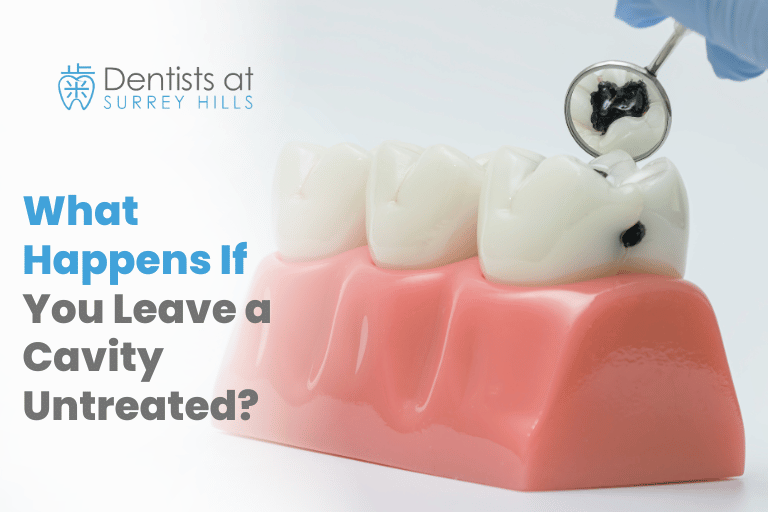
Leaving a cavity untreated allows tooth decay to continue deeper into the tooth. A small cavity may eventually cause sensitivity or pain, weaken the tooth and, if the decay reaches the centre of the tooth, lead to infection.
The important thing is that cavities do not all progress at the same speed. You may also have very few symptoms at first. Feeling no pain does not necessarily mean the cavity has stopped getting worse.
Treating decay earlier usually means there is more healthy tooth structure left to preserve and the treatment may be simpler.
What Happens as a Cavity Gets Deeper?
A tooth has several layers. The hard enamel forms the outside of the tooth. Beneath it is dentine, and deeper inside is the pulp, which contains nerves and blood vessels.
Decay usually begins at the surface and can gradually move through these layers if it is not stopped.
This means an untreated cavity can change from a relatively small problem into one that affects the deeper parts of the tooth.
The Cavity Can Get Larger
Once a physical hole has formed in the tooth, it cannot simply grow back.
As decay continues, more tooth structure can be damaged. A cavity that could initially be repaired with a filling may eventually become too large for a simple filling alone.
You can read more about how tooth decay develops and what causes the enamel to break down.
Your Tooth May Become Sensitive
As decay moves beyond the enamel and reaches the dentine underneath, the tooth may become more sensitive.
You might notice discomfort when you have:
- cold drinks
- hot foods or drinks
- sweet foods
- pressure from biting or chewing
Sensitivity does not tell you exactly how deep a cavity is, however. Some cavities can become quite advanced before they cause obvious discomfort.
Can a Cavity Reach the Nerve?
Yes.
If decay continues far enough, it can reach the pulp in the centre of the tooth. This is where the nerves and blood vessels are located.
At this stage, you may develop a stronger or more persistent toothache. Pain may linger after eating or drinking something hot or cold, or the tooth may begin hurting without an obvious trigger.
The progression of untreated tooth decay can eventually involve the pulp and cause toothache.
Once the pulp has become badly inflamed or infected, a filling alone may no longer be enough to treat the tooth.
Can an Untreated Cavity Cause an Infection?
Yes. Bacteria can eventually reach the pulp and cause an infection inside the tooth.
The infection can then spread through the root of the tooth and lead to a dental abscess.
Possible signs include:
- severe or throbbing toothache
- pain when biting
- swelling around the tooth or gum
- a bad taste in the mouth
- pus around the affected area
- swelling of the face or jaw
An abscess needs dental treatment. It is not a good idea to wait for the pain to disappear on its own.
In fact, pain can sometimes decrease if the nerve inside a badly damaged tooth dies. That does not necessarily mean the problem has resolved.
Could You Need Root Canal Treatment?
If decay has reached and infected the pulp but the tooth can still be saved, root canal treatment may be recommended.
During root canal treatment, the infected or damaged tissue inside the tooth is removed. The inside of the tooth is then cleaned and sealed so the natural tooth can remain in place.
This is quite different from treating a smaller cavity with a filling, which is another reason not to wait until a tooth becomes painful before having it checked.
Can a Cavity Weaken or Break the Tooth?
It can.
As a cavity becomes larger, there is less healthy tooth structure remaining. Eventually, the tooth may become weak enough to crack or break, particularly when biting something hard.
A larger cavity or weakened tooth may need more extensive restoration. In some cases, a dental crown may be used to cover and protect a tooth that has lost too much structure for a filling alone.
The treatment depends on how much healthy tooth remains and whether the pulp has also been affected.
Can You Eventually Lose the Tooth?
Unfortunately, yes.
Dentists generally try to preserve a natural tooth when it can be predictably restored. But if decay has destroyed too much of the tooth, or an infection has caused extensive damage, saving it may no longer be possible.
Extraction may then need to be considered.
This does not mean every untreated cavity will end in tooth loss. It means that allowing decay to continue can gradually reduce the treatment options available.
How Long Can You Leave a Cavity Untreated?
There is no reliable answer such as a few weeks, six months or a year.
Cavities do not progress at exactly the same rate in everyone. The location and size of the decay, oral hygiene, diet, saliva and other factors can affect how quickly it develops.
Waiting until a cavity hurts is also unreliable because early tooth decay may cause no pain at all.
If a dentist has already found a cavity, it is better to follow the recommended treatment plan rather than waiting for symptoms to appear.
What If the Cavity Does Not Hurt?
It still needs attention.
Pain usually becomes more likely as decay reaches deeper parts of the tooth, but the absence of pain does not tell you that a tooth is healthy.
Decay can also develop in places that are difficult to see yourself, including between teeth. Dental X-rays are sometimes needed to find decay that is not obvious during a visual examination.
This is why a cavity can sometimes be discovered during a routine check-up before you realise anything is wrong.
Is It Better to Treat a Cavity Early?
Generally, yes.
A smaller cavity may only require removal of the decayed area and a filling. If the decay continues deeper, treatment can become more involved.
The progression can look something like this:
Early decay → cavity → deeper decay → pulp damage or infection → more extensive treatment
Not every cavity follows exactly the same path, and early changes to the enamel may sometimes be managed before a physical hole forms. Once a cavity is present, however, it should be assessed rather than simply watched at home.
When Should You See a Dentist?
You should arrange a dental examination if you notice:
- toothache
- new sensitivity to hot, cold or sweet foods
- pain when biting
- a visible hole in a tooth
- a dark or white area that has changed
- a chipped or weakened tooth
- swelling around a tooth or gum
You should also have a cavity treated if it has already been identified, even if it is not causing pain.
If you develop significant facial swelling, severe pain or other signs of a spreading dental infection, seek prompt dental or medical care.
The Bottom Line
A cavity may start small, but leaving it untreated gives decay more opportunity to damage the tooth. As it progresses, a filling may no longer be enough, and treatment can become more extensive.
If you think you may have a cavity, an experienced dentist can check how far the decay has progressed and determine the most appropriate way to treat the tooth.